
While Nifty 50 reflects changes in 40 years, it also shows what is missing: Low-cost manufacturers at one end, and deep-value players at the other. Also missing are technology players, observes T N Ninan.

On the BSE, 1,650 shares declined and 1,188 shares rose

The index widened its loss towards the fag-end on emergence of intense selling in heavyweights like ITC, RIL and ICICI Bank. In percentage terms, however, Sun Pharma was the biggest loser with 9.39 per cent drop. Intra-day, the pharma major's shares tanked over 20 per cent.

The rupee has lost ground since pre-Budget, against three major hard currencies (yen, dollar and euro). The European Central Bank and the Bank of Japan maintained status quo in recent policy meetings

Very gradual fiscal consolidation glide path with looser-than-expected fiscal policy; good quality spending mix and reasonable assumption on fiscal math; and focus on privatisation, asset monetisation and long-term funding for infrastructure investments, according to Morgan Stanley, are the three key themes from the Budget 2021.


According to a new report by international management consulting firm Arthur D Little, the worst of COVID-19's impact will be felt by India's most vulnerable in terms of job loss, poverty increase and reduced per-capita income, which in turn will result in a steep decline in the Gross Domestic Product (GDP). "Given the continued rise of COVID-19 cases, we believe that a W-shaped recovery is the most likely scenario for India. This implies a GDP contraction of 10.8 per cent in FY 2020-21 and GDP growth of 0.8 per cent in FY 2021-22," the report said.

India lost around 38.5 thousand hectares of tropical forest in the last decade. Nearly 14 per cent of the country's tree cover! It is one thing for Modi to announce that India will reach a net-zero level of emissions in 2070. But if it is serious, it needs to start today, points out Ramesh Menon.

Reliance improved its ranking this year to 121 from 142 last year, with a market value of $50.6 billion and assets worth $91.5 billion.

Index heavyweights Reliance Industries and ITC were the top losers along with ICICI Bank and SBI
Broader gains were capped as investors awaited corporate results from major firms

Top gainers in the Sensex pack included Tata Motors, Bajaj Auto, HDFC twins, IndusInd Bank and RIL, rallying up to 3.23 per cent.
'The Indian economy is in slowdown and growth may stay slow,' notes Devangshu Datta.

External Affairs Minister S Jaishankar said on Friday that India and China are going through a 'particularly bad patch' in their ties because Beijing has taken a set of actions in violation of agreements for which it still doesn't have a 'credible explanation' and it is for the Chinese leadership to answer where they want to take the bilateral relationship.

Weakness of dollar in the overseas market also boosted the domestic currency, a forex dealer said.

In the broader market, the S&P BSE Midcap and the S&P BSE Smallcap indices gained 0.5% and 0.4%, respectively.

Managing Brexit, inflation and banking reforms, along with the political environment, will be tough.

With automation taking place at a much faster pace across industries especially in the tech space, domestic software firms that employee over 16 million are set to slash headcounts by a massive 3 million by 2022, which will help them save a whopping $100 billion mostly in salaries annually, says a report. The domestic IT sector employs around 16 million, of them around 9 million are employed in low-skilled services and BPO roles, according to Nasscom. Of these 9 million low-skilled services and BPO roles, 30 per cent or around 3 million will be lost by 2022, principally driven by the impact of robot process automation or RPA. Roughly 0.7 million roles are expected to be replaced by RPA alone and the rest due to other technological upgrades and upskilling by the domestic IT players, while it the RPA will have the worst impact in the US with a loss of almost 1 million jobs, according to a Bank of America report on Wednesday.

Hydrography (underwater geography) prevents the Indian Navy for opting for an all-conventional, or all-nuclear submarine fleet.

A group of investors of Japanese mobile giant SoftBank has sought probe and possible sacking of its India-born COO Nikesh Arora over potential conflicts of interest tied to his role as an adviser to a private equity firm.

A billion dollars in renewable energy is huge.

The Rs 1.10 lakh crore train project between Ahmedabad and Mumbai is expected to be completed by 2022. The train would cover the distance of over 500 km in around two hours.

Other losers included Vedanta, Tata Steel, NTPC, ONGC, L&T, M&M, Coal India, Maruti, PowerGrid, Axis Bank, ITC and HDFC, dropping up to 5.75 per cent. On the other hand, Kotak Bank, Bharti Airtel, HCL Tech, Bajaj Finance and Hero MotoCorp rose up to 0.95 per cent.

'India is possibly the most fiscally constrained market in the region.'

Under the new model, the IT services firm will replace the current structure of its various strategic business units, service lines and geographies with four strategic market units and two global business lines.

Gold, which was hovering around $1,321 an ounce in January 2019, has already breached $1,600 per ounce in the past few sessions to a seven-year high.

'Do some profit booking and bring your equity allocation back to its original level.'

Reflecting the bullish mood, all sectoral indices ended with gains, led by auto, oil and gas, FMCG, IT and teck. The broader NSE Nifty, after crossing the 10,600-mark, settled 68.40 points, or 0.67 per cent higher at 10,598.40.

United States Defence Secretary Lloyd J Austin arrived in India on Friday on a three-day visit, aimed at further boosting bilateral defence and security ties in the wake of China's growing military assertiveness in the region including the Indo-Pacific.
Weakness of dollar in the global markets and foreign capital outflows also affected the rupee sentiment.

India's foreign reserves continue to march to record highs, touching USD 393 billion early this month backed by strong foreign portfolio and investment flows, according to Development Bank of Singapore.

NTPC was the top gainer, spurting 4.28 per cent. Other winners were Bajaj Auto, Bajaj Finance, Sun Pharma, ITC, Hero MotoCorp, TCS, Yes Bank, HDFC, HDFC Bank and SBI, rising up to 1.38 per cent.
However, if the rupee depreciates much, the economy in dollar terms would be that much smaller.

It was an extraordinary turnaround for an Olympics that was expected to be held without major issues by a country known for public safety and economic stability. It also revealed a fatal miscalculation by Japanese and IOC officials of public sentiment at a time of heightened fears over the coronavirus.

'Modi and Abe are working seriously for India-Japan bonhomie to grow stronger.' 'It is a win-win situation for both countries and the future look promising,' says Rajaram Panda, the Indian Council for Cultural Relations India Chair Visiting Professor at Reitaku University, Japan.

The rupee bounced back by four paise to close at 65.27 per dollar on fresh selling of the American currency by banks.

The market breadth, indicating the overall health of the market, was positive

Pharma major Sun Pharma remained the worst loser in the Sensex pack for the second day in a row after reports that regulator Sebi may reopen the insider trading case against the company.
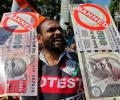
'In the total of black wealth, only 1% or less than 1% constitute cash.' 'So, even if cash is completely weaned out, it impacts only 1% of the black wealth.'

Indian equities are in a multi-year bull story with capex cycle recovery as the main driver.
 © 2026 Rediff.com - Advertise with us - Disclaimer - Privacy Policy - Sitemap - Feedback - About us - Terms of use - Grievances